
IVR navigation: How AI voice agents automate phone menus
- Written by
- Jack Limebear
- Published
- Last updated
ListenListen to this article
IVR navigation is the process of automatically working through an interactive voice response (IVR) menu. Instead of a person having to 'Press 1 for billing' and '5 to query your balance,' an AI agent navigates these phone trees on their behalf, only looping them back in once the final objective has been reached.
For businesses, this unlocks a category of work that was previously impossible to automate. Countless operational workflows depend on calling third-party phone systems: verifying a patient’s insurance coverage, refilling a customer’s prescription, or checking a shipment status with a carrier.
Until now, IVR menus created a hard barrier for AI voice agents. Once a human picked up, an agent could hold the conversation. Getting to that point required a person to manually battle through the phone tree first.
ElevenLabs has closed that gap. ElevenAgents generates keypad tones as a system tool across telephony stacks, allowing agents to interact with IVR systems directly. From listening to the options to deciding which is correct and pressing it, our AI agents automate the entire process, on behalf of your business and every one of your customers.
Summary:
- IVR navigation lets AI voice agents work through third-party phone menus on behalf of your business and its customers, only looping a human in when the goal is reached.
- ElevenAgents generates DTMF keypad tones as a system tool across telephony stacks, letting agents interact with legacy IVR systems directly.
- Navigating IVR trees is challenging due to timing, multi-layer menu depth, provider differences, and changing menus.
- Businesses use IVR navigation to automate workflows like insurance verification, pharmacy refills, and flight status checks at scale, with the agent entering each customer’s own details.
- IVR navigation means an agent calls out and navigates someone else’s phone tree, while conversational IVR replaces a company’s own inbound phone menu with an AI agent.
What is IVR and DTMF?
IVR stands for interactive voice response, a category of automated phone systems that guide the caller through fixed conversational routes. Typically, IVR works with either spoken input or keypad presses. It’s been around for decades, dating back to the 1970s and still forming a part of numerous customer support phone systems today.
When a caller interacts with IVR systems using a keypad, they’re engaging with DTMF (dual-tone multi-frequency signaling). Every number on a phone keypad or screen maps directly to a frequency pair. When played together, the machine parses the signal as receiving a specific digit. This technology underpins the common mechanism that you’ll have run into at least once of “Press 1 for billing, 2 for human resources, or 3 for account services.”
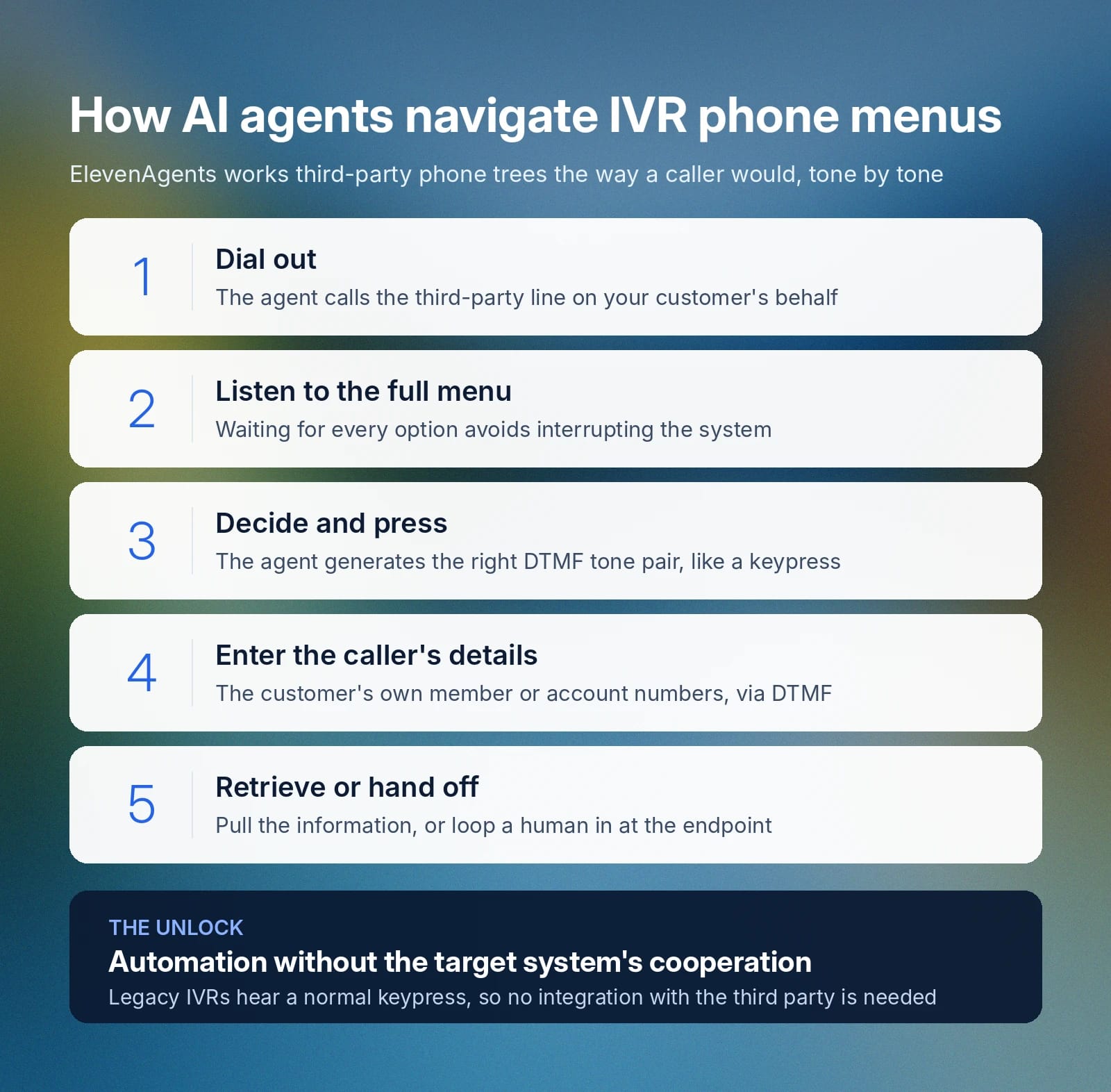
This context matters because even though AI agents can now automate the process, they still interact with legacy IVR the same way a human caller would. Instead of 'speaking' a number out loud, an AI agent generates the correct tone pair and sends it down the line, mirroring the outcome of a human pressing the button. This is what makes automated phone tree navigation possible without any cooperation from the system being called.
Why IVR navigation is challenging for voice agents
While playing a specific tone may seem fairly trivial on paper, there are several processes occurring behind the scenes that make navigating a third party's IVR tree challenging.
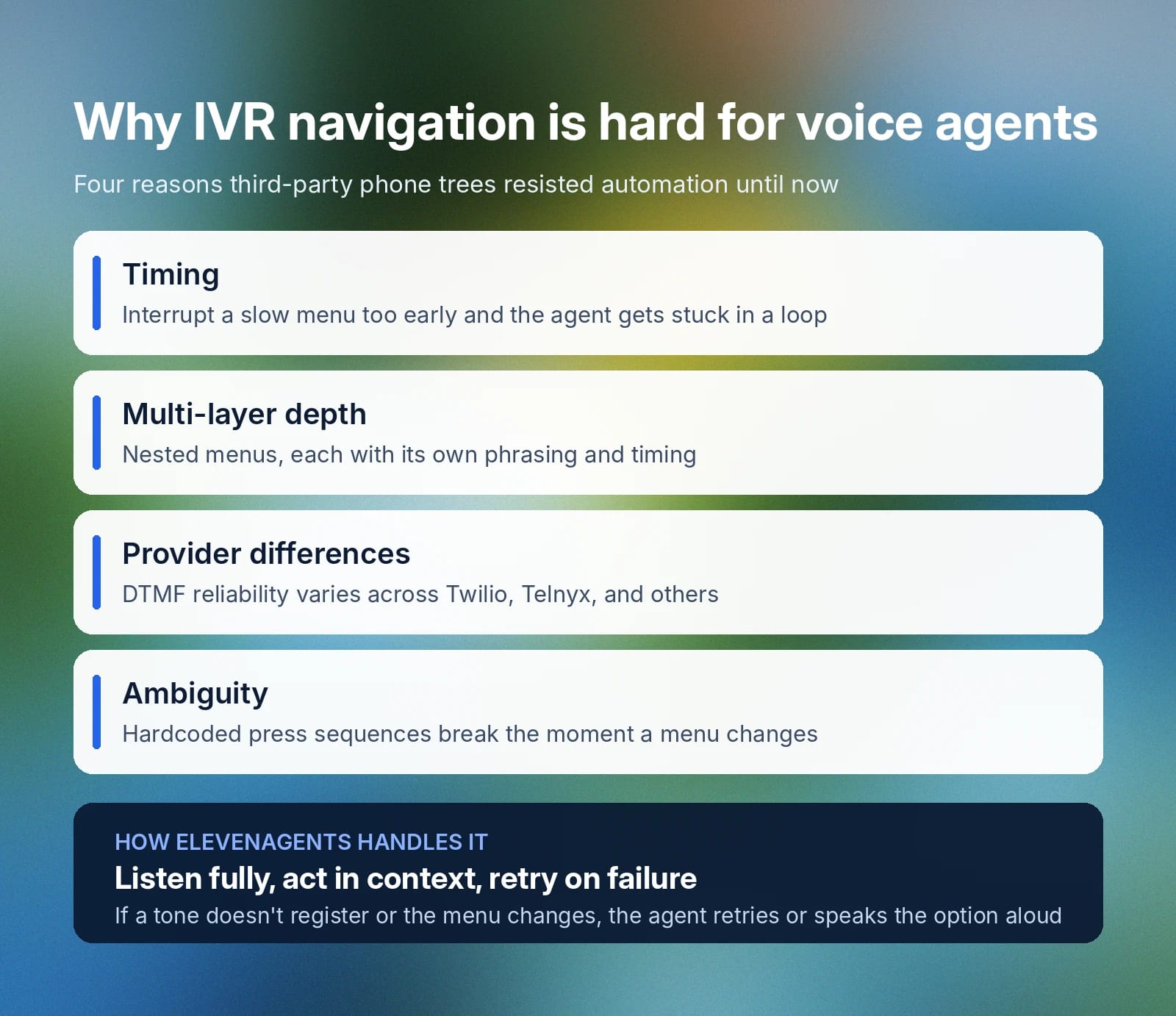
These are the main reasons why it was difficult for AI agents to move through IVRs:
- Timing: IVR systems tend to speak slowly and in a monotone voice, potentially even pausing between options. An AI agent needs to intuit when the full menu has been read out or it risks interrupting the machine before it’s ready to receive input. This is especially the case with clunky voice-based IVR systems, as interrupting them early might derail the flow and keep the agent stuck in a loop.
- Multi-layer depth: When contacting an enterprise, agents may have to work through several increasingly narrow layers to find the correct endpoint. Reaching a specific outcome across nested options, each with its own phrasing and timing in place, is complex.
- Provider differences: How reliably a DTMF tone lands depends on the telephony layer that supports it. All major providers like Twilio and Telnyx behave slightly differently here, so the same tone-sending logic needs to work across distinct carriers.
- Ambiguity: A hardcoded sequence of button presses breaks as soon as a company changes their internal menu map. Agents have to adapt in real time, correctly navigating a phone tree they have no prior knowledge of.
ElevenAgents handles these challenges by listening to the full menu before acting, building up contextual awareness of what each option means, and then generating the correct tone sequence. Even if a menu changes or a tone doesn’t register, the agent can retry or resort to speaking the option aloud, designed to work across a wide range of IVR systems.
How businesses automate IVR navigation for their customers
The core B2B use case for IVR navigation is outbound: your agents call third-party phone systems on behalf of your customers, at scale. Instead of a human operations team sitting on hold, an agent dials out, works through the phone tree, enters the customer's details via DTMF, and either retrieves the information directly or hands off once a human picks up.
For example, take a benefits platform that needs to retrieve information held by external providers. When a customer makes a request, an agent dials the provider’s line, navigates the automated phone menu, and enters the customer’s account details, not the company’s own. The agent works through each layer of the tree until it reaches the right endpoint, pulls the information the customer needs, and reports back. What used to be a queue of manual calls becomes a workflow that runs in parallel, around the clock.
Here’s what that pattern looks like across industries:
- Customer detail and insurance verification: The agent dials an insurance company’s line, navigates to provider services, selects benefits verification, and enters the customer's member ID. It waits on hold until a human agent becomes available, then relays control back to your team or the customer once they pick up.
- Requesting a pharmacy refill: The agent calls the pharmacy’s automated refill line, entering the customer's prescription number and any other necessary details via DTMF. The system confirms the request and reports that the prescription is ready for pick-up, which the agent relays to the customer.
- Flight status management: The agent navigates through an airline’s IVR call center, finding the option for existing reservations and entering the customer's reservation number. From there, it receives an update on the booking and can initiate further actions, like rebooking or canceling the flight, depending on what the customer needs.
In each of these cases, the structure is the same: the agent acts on behalf of the caller, with the caller’s details, and only involves a human when the objective requires one. IVR automation removes the queue and the manual button-pressing from your operations entirely.
Get started with IVR navigation in ElevenAgents
Workflows that previously required a person to call, wait, and click through multiple layers of automated phone menus can now be fully automated by IVR navigation. Combined with natural voice interactions, ElevenAgents lets you automate phone-based IVR navigation tasks your business handles, reducing the need for manual effort.
Pair IVR navigation with Reception by ElevenAgents for inbound call handling, so every call your business makes and receives runs through the same ElevenAgents stack.
For more information, read our docs on the play keypad touch tone tool or get started with your very own voice agent by contacting sales today.